

Initiator of Bolashaq.me and the Talimger project
Camp concluded · Mangystau Region · 10–17 August 2026
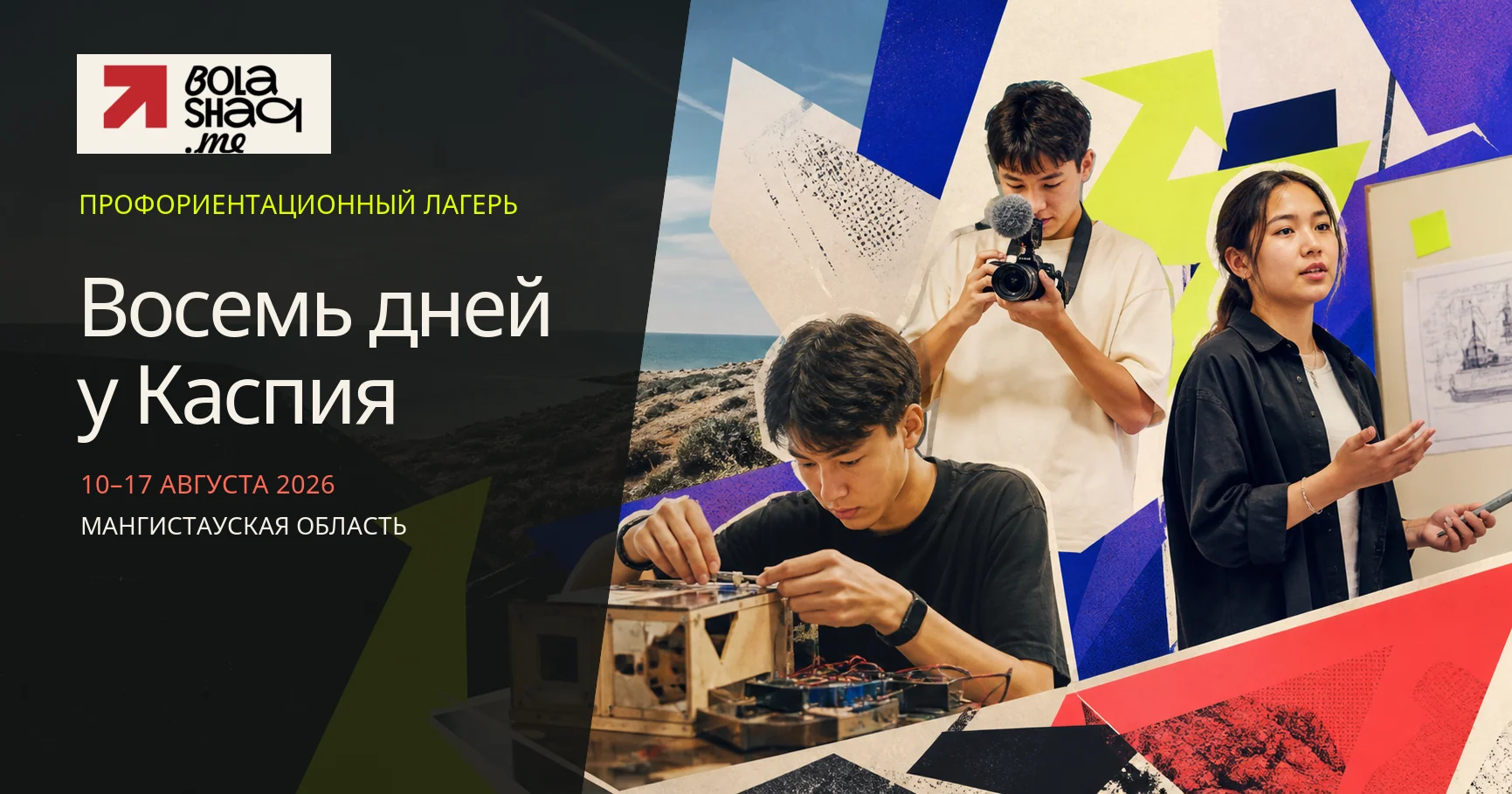
Eight residential days on the Caspian coast brought together teenagers from cities and districts across the Mangystau Region who had completed a competitive selection process. Career guidance became practical: participants explored professions, tried team roles, worked with AI, created projects and tested solutions with their own hands.
Alongside the teen programme, the camp hosted a practice lab for career guidance educators. Practitioners selected through a regional competition learned and rehearsed new tools in the morning, then used them with teen teams that same day.
01 / About the project
In 2025, Тәлімгер began sustained work across the Mangystau Region: training educators in career guidance and entrepreneurship, creating a regional methodology centre and running competitions for career guidance practitioners and youth teams. The summer camp brought these strands together in one place.
230educators completed training in 2025
11educators earned places at the summer business camp through the regional competition
6youth teams earned places at the summer business camp
Bolashaq.me is a career guidance platform and charitable initiative. The camp brought that work into a shared physical space through teamwork, project-making and conversations with trained practitioners.
This is a region-wide effort, not a project for one city. The Тәлімгер network connects Aktau, Zhanaozen and districts across the Mangystau Region.
The camp is organised and methodically led by the Тәлімгер public foundation, which supports social initiatives and innovation in education.
How the regional project developed (Russian)Regional competition results (Russian)Project ecosystem
The Bolashaq.me career-guidance platform was launched by the Halyk Charitable Fund as part of the Talimger project. The camp continues this work in the Mangystau Region. The Talimger Public Foundation organises the camp and leads its methodology; the regional programme is supported by the Akimat of the Mangystau Region.
Halyk Foundation on the Talimger programme in MangystauInitiator of Bolashaq.me and the Talimger project

Camp organiser and methodology lead
Mangystau Region — where the programme takes place
02 / Inside the programme
These are not six separate clubs. A single challenge may combine movement, research, a team role, technology and a public presentation of the result.
Teenagers make structures and prototypes, find weak points and revise their solution after testing it.
Morning exercise, active games and team challenges develop not only speed, but also tactics, mutual support and responsibility.
Participants develop their team’s visual language, create photographs and videos, and work with text, imagery and the presentation of results.
Across different challenges, a teenager may lead, investigate, build, explain or help the group reach agreement — and discover which work suits them best.
Teams gather evidence, define a challenge, create an initial solution, show it to people and improve it.
AI helps participants find possibilities and examine future scenarios. People still decide what matters and which path to take.
03 / Journey
Participants observed how they acted within a team, explored professions, identified a problem worth solving, and worked together from a practical challenge to a tested prototype.
A quest, collaborative challenges and guided reflection help each teenager notice when they take the lead, how they reach agreement and which kinds of tasks make them feel most capable.
Career stations and AI-supported research reveal the tasks, tools, decisions and working conditions behind a job title.
Participants explore the camp environment, speak with people, choose one meaningful problem, build an initial solution and gather feedback.
The team investigates a practical challenge, gathers evidence, builds a model or working prototype, tests it with people and explains its choices.
04 / Day by day
This is a retrospective learning arc, not an hour-by-hour timetable: eight days from first introductions and self-observation to career research, an entrepreneurial experiment, a prototype and a final presentation.
The camp begins on the journey. After arrival, participants meet, join their teams, agree on how they will live and work together, and introduce themselves to the whole camp.
Through team and career-exploration challenges, participants try different roles. They then review specific moments with a career guidance educator: what felt natural, what took effort and what contribution the team noticed.
Teenagers investigate real tasks from different professions, ask questions, compare sources and use AI to examine several ways work and required skills may change by the time they enter adult life.
Teams learn to notice people’s needs, choose one clear problem and turn an idea into a simple, testable solution. Here, entrepreneurship begins with two questions: who needs this, and why?
Teams receive a real-world challenge and first study its context: the people involved, available evidence, different interests and constraints. They only begin designing after asking questions and checking their assumptions.
The team creates a model or working prototype, shows it to people, records what was unclear or inconvenient and then revises the solution.
Participants refine the visual presentation, practise explaining the project clearly, demonstrate the prototype, divide speaking roles and answer questions. Teams then present the results of their work.
Participants revisit the most important moments from all eight days, record what they learned about themselves, choose a next experiment for life after camp, preserve their team story and travel home.
05 / Outcomes
Teenagers learn by doing, while career guidance educators learn to observe that action more precisely. Each group has its own outcome, created through shared work.
The team collected the programme’s working and methodological materials. If you work with school students, want to learn from our findings or discuss running a similar camp, we welcome a exchange of experience.
+7 701 333 9999Camp materials are not published as an open journal, but the team is ready to share approaches and discuss collaboration.
Learn about the materials ↗06 / After camp
The final day took place on 17 August. Participants brought the programme to a close, preserved shared memories and travelled home.